

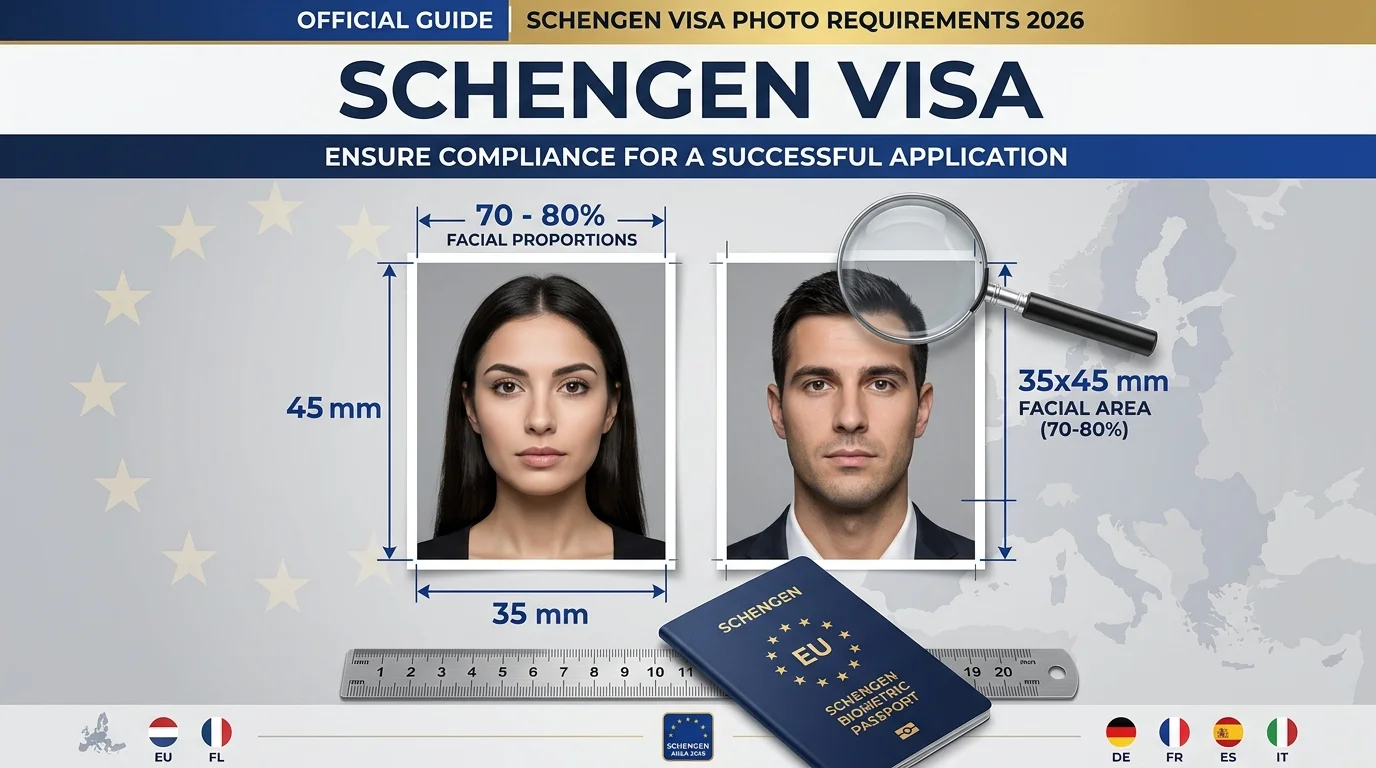
Applying for a Schengen tourist, business, student, or transit visa requires submitting biometric passport photographs that conform strictly to ICAO Doc 9303 and European Commission Regulation (EC) No 810/2009 (Visa Code). Consular officers and external processing contractors like VFS Global, TLScontact, and BLS International routinely reject visa applications solely due to non-compliant photo dimensions, incorrect face ratios, or improper background contrast.
Using PixDok's Online Schengen Visa Photo Maker, applicants can crop, calibrate, and format their portraits to exact European consular specifications in seconds—generating both a single compliant 35x45 mm digital image and an 8-photo printable 4x6" (10x15 cm) sheet ready for immediate physical submission.
| Technical Specification | Official ICAO / Schengen Requirement | PixDok Automated Calibration |
|---|---|---|
| Photo Width & Height | 35 mm wide × 45 mm high (3.5 cm × 4.5 cm) | Exact 35×45 mm (Aspect ratio 7:9) |
| Face Height (Crown to Chin) | 32 mm to 36 mm (70% to 80% vertical frame height) | Dual biometric guideline markers at 32 mm and 36 mm |
| Top Hair Margin (Headroom) | 3 mm to 5 mm clear space between hair and top border | Built-in headroom spacing guides |
| Eye Line Position | 28 mm to 35 mm measured from bottom border | Horizontal eye-level centering crosshair |
| Background Color | Uniform light grey (#E5E7EB) or light neutral tone | Pre-calibrated EU Light Grey or Light Blue backdrop |
| Resolution & Sharpness | Minimum 300 DPI for physical printing; 600 DPI preferred | Ultra-high-resolution 826×1062 px raster export |
1. Universal Acceptance Across All 29 Schengen Area Nations
The Schengen Area encompasses 29 European nations that have abolished internal border controls. Because biometric visa data is synchronized into the central Visa Information System (VIS) database, the photographic rules are completely uniform. A photo prepared to Schengen standards is accepted identically by all 29 member states:
- Western & Central Europe: Austria, Belgium, Czech Republic, France, Germany, Hungary, Liechtenstein, Luxembourg, Monaco (via France), Netherlands, Poland, Slovakia, Switzerland.
- Southern Europe: Croatia, Greece, Italy, Malta, Portugal, San Marino (via Italy), Slovenia, Spain, Vatican City (via Italy).
- Northern Europe: Denmark, Estonia, Finland, Iceland, Latvia, Lithuania, Norway, Sweden.
- Eastern Europe (Fully Integrated 2024): Bulgaria, Romania.
2. Face Height & Head Positioning Tolerances
The most common cause of consular photo rejection is incorrect head scaling. In a casual passport booth, portraits often capture too much shoulder area, shrinking the face below the required 32 mm minimum. Conversely, aggressive cropping that magnifies the face above 36 mm cuts off the applicant's jawline or forehead.
- Face Measurement Boundary: The distance is measured from the tip of the chin to the top of the skull crown (excluding high hairstyles, poofs, or voluminous curls). This distance must measure between 32 mm and 36 mm.
- Head Tilt & Gaze: The applicant's head must be held upright without tilting toward either shoulder (zero degrees roll) and without tipping backward or chin-tucked (zero degrees pitch). Both eyes must look directly into the camera lens with pupils clearly visible and unshadowed.
- Shoulder Alignment: Both shoulders must appear balanced and square to the camera. Side-profile, artistic three-quarter poses, or candid snapshots will be rejected immediately by consular scanning software.
3. Background Tone: Why Light Grey Outperforms Plain White
While the US Department of State strictly mandates pure white backgrounds for US visas, the European Union Visa Code specifies a "plain, light-toned background with no patterns or shadows." German, French, and Italian consular technical guidelines specifically advise against bright pure white (#FFFFFF), especially for applicants wearing light-colored clothing.
When an applicant wears a white dress shirt or light blouse against a pure white backdrop, the boundary edges between the shoulders and the background disappear completely into optical overexposure. Consular edge-detection algorithms cannot verify biometric contours, resulting in rejected documentation. Choosing PixDok's calibrated Light Grey (#E5E7EB) backdrop provides the required diffuse contrast while remaining 100% compliant with European consulate specifications.
4. Eyeglasses, Headwear & Facial Expression Rules
Strict Rules on Eyeglasses
Consulates and visa processing centres strongly recommend removing eyeglasses entirely for your photo. If you must wear prescription eyeglasses due to verified medical necessity:
- The frames must be thin and delicate; thick tortoiseshell, chunky plastic, or bold dark frames that obscure the eyebrows, eyelids, or iris contours are prohibited.
- The lenses must be completely clear without any tint, polarization, or photochromic transition shading.
- There must be zero flash glare, reflection, or white hot-spots bouncing off the glass surface into the camera lens.
Religious Head Coverings (Hijab, Turban, Kippah)
Under Annex 11 of the European Visa Code, religious head coverings are fully accommodated provided that facial biometric features remain unobstructed:
- The entire facial oval from the tip of the chin to the top of the forehead (above the eyebrows) must be completely visible.
- Both cheek contours must be uncovered; the fabric must not wrap tightly across the jawline or cast shadows over the cheeks.
- Headwear must be solid-colored without vibrant printed patterns or reflective jewelry.
Facial Expression & Smile Restrictions
Applicants must maintain a strictly neutral facial expression with their mouth firmly closed. Smiling, smirking, showing teeth, raising eyebrows, or frowning distort the geometric distances between facial landmarks (nasal base, oral commisures, and eye corners) used by biometric border control gates.
5. Special Provisions for Babies, Toddlers & Children
Photographing infants and toddlers under 5 years of age can be challenging. Consulates provide sensible leeway:
- Infants Under 1 Year: Do not require direct camera gaze, and slightly open mouths are tolerated. You can lay the baby on a smooth light grey sheet or position them in an infant car seat draped with a light grey blanket.
- Zero Auxiliary Elements: No supporting parental hands, fingers, pacifiers, baby bottles, bibs, or toys may appear anywhere within the cropped 35x45 mm frame.
- Children Aged 1 to 5: Should maintain an upright front-facing pose, but minor head tilt is tolerated. Using the PixDok Schengen Visa Photo Maker, parents can easily nudge and scale the photo to achieve the required 32–36 mm facial oval.
6. Printing Your 4x6" Sheet with 8 Identical Photos
PixDok automatically arranges 8 calibrated 35x45 mm photographs onto a standard 4x6 inch (10x15 cm) postcard sheet with fine alignment borders. To print physically:
- Export the
Schengen_Visa_Photo_4x6_Sheet_PixDok.jpgfrom the tool. - Upload the file to any photo lab kiosk (Walgreens, CVS, Walmart, Boots, Snappy Snaps, CEWE, DM Drogerie, or your local print shop).
- Order a standard 4x6" photographic print on glossy or semi-matte photo paper (200 gsm or higher).
- Crucial: Ensure the printer scaling is set to 100% (Actual Size). Turning on "Fit to Page" will reduce the physical size by 3–5%, rendering the photos non-compliant.
- Carefully cut along the cutting border marks with a paper trimmer or scissors.
Need photos for other jurisdictions? PixDok also provides specialized online tools for Global Passport Photos, UK Passport Photos (35x45 mm, 29–34 mm head), and US Visa Photos (2x2 inch square).